




















Mail-in ballot envelope holes serve a sight-impaired accessibility function and do not expose voter selections.
In the lead-up to the Nov. 4 special election on Proposition 50, the California constitutional amendment that would put an end to the Independent Redistricting Commission, allowing Sacramento to redraw congressional maps through 2030.
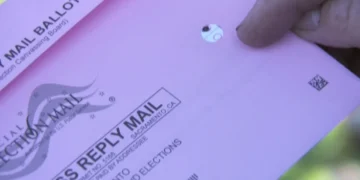
Viral videos have floated a false theory: that the small holes in mail-in ballot return envelopes allow someone to see how a voter cast their ballot.
That is not the case. Shirley Weber, California Secretary of State, released a statement, “The small holes on ballot envelopes are an accessibility feature to allow sight-impaired voters to orient themselves to where they are required to sign the envelope.”
She added that if voters are concerned about their vote being revealed — some of the videos online show that “No” votes can be made visible through the holes in some envelopes — they can fold or insert their ballot in a way where their choice remains hidden.
Counties across California use different envelope designs, adding to the confusion. For example, Ventura County’s holes are located below the signature line, while Orange County’s envelopes have none at all, according to LAist.
In Los Angeles County, envelopes contain three holes in total—two near the signature box to help visually-impaired voters locate the signing area, and a third overlapping hole that allows election workers to verify the envelope is empty once ballots are removed.
The holes were recommended by the nonprofit Center for Civic Design, and Secretary Weber said her office encourages counties to follow the group’s guidance, which is available on the Secretary of State’s website.
Still, to ease any voter concerns that the holes might allow visibility of a marked “Yes” or “No” on Prop 50, officials suggest a simple step: fold or insert your ballot so that the blank side faces the holes–or drop the ballot off in person.
Meanwhile, early turnout data show about 1.8 million ballots returned as of Oct. 16, roughly 7.8 percent of mailed ballots, for the special election.
Californians concerned about election integrity and transparency, the envelope-hole myth can be laid to rest: the feature exists for accessibility and administrative verification, not vote exposure.